Building a Future-Proof Municipal Network: Celina's Journey to Modern Infrastructure
How the City of Celina Built a Scalable, Future-Proof Municipal Network with Arista L3 EVPN/VXLAN Leaf-Spine Architecture and DWDM.

When I joined the City of Celina, it became clear we needed a robust, scalable network infrastructure to match the City's growth. At the time, the City operated a handful of network sites with a few leased lit services, supporting roughly 220 employees and serving a population of about 28,000. Celina's network underpins critical public services: parks, libraries, police, fire/EMS, SCADA systems, traffic management, and much more.
We had a rare opportunity, design something that would stand the test of time. The new network needed to be agile, flexible, and highly resilient, bringing a modern approach to local government in one of the fastest-growing cities in the Dallas-Fort Worth metroplex.
The Limitations of Traditional Networks
Most municipal networks rely on a classic ring topology. Sites connect linearly to their neighbors, with every fourth site linking back to a central hub. This design mirrors the physical layout of the locations on a fiber ring and has served many communities well—it's simple, proven, and straightforward to implement.
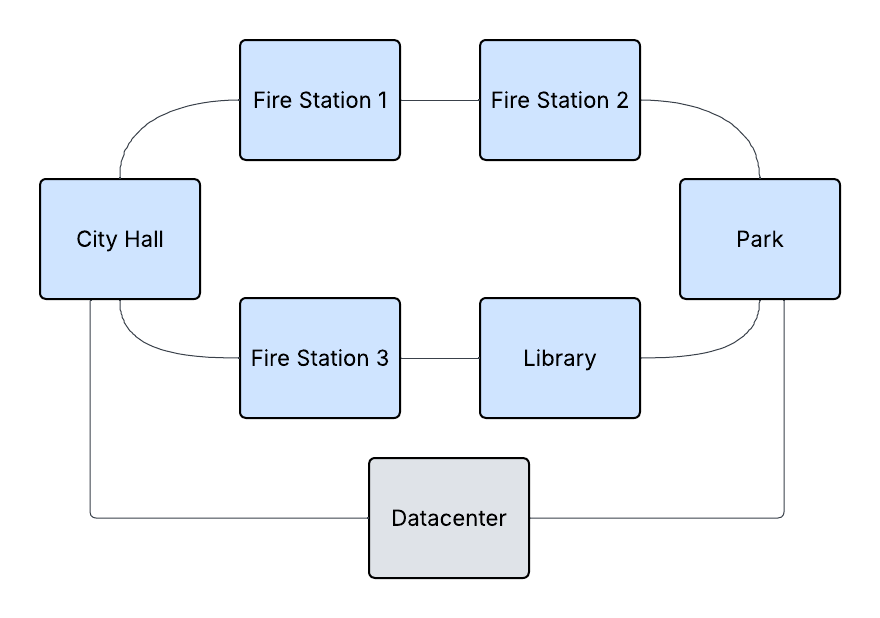
However, it wasn't the right fit for Celina. Ring topologies can be slow to converge after failures, depend heavily on reliable power and stable neighboring sites, and often bottleneck bandwidth at intermediate locations. In a high-growth environment like ours, where new facilities, services, and demands emerge rapidly these constraints aren't sustainable. We needed a design that could keep pace with innovation and expansion.
Embracing Arista Validated Designs (AVD)
To push beyond traditional limits, we turned to Arista Validated Designs (AVD). Arista provides a comprehensive set of best-practice architectures with standardized, repeatable configurations. While every city faces unique challenges, we saw the potential to build truly innovative infrastructure.
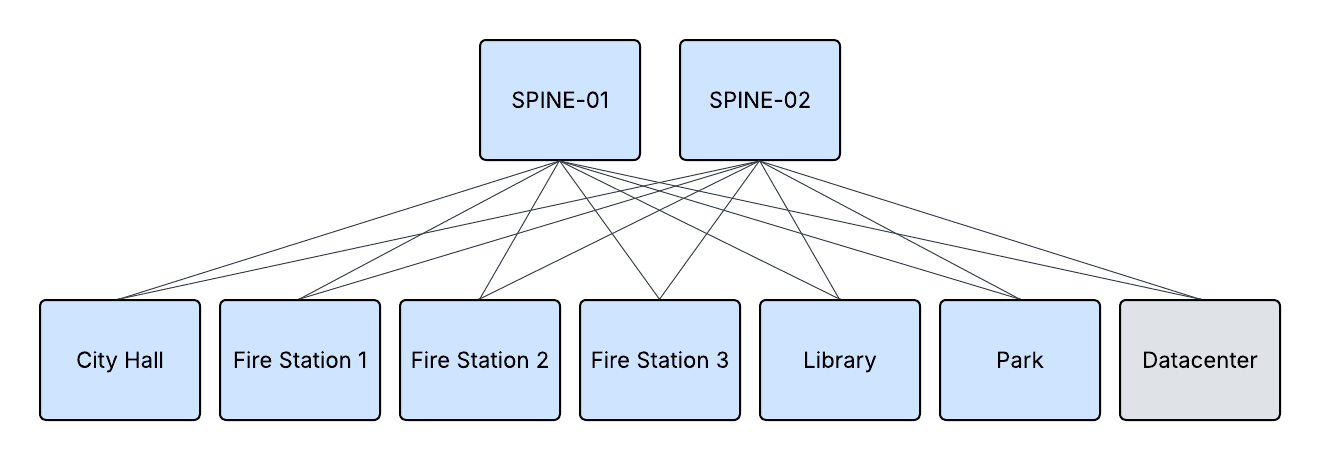
Collaborating with our Arista account team and engineers from other local municipalities, we selected a Layer 3 EVPN/VXLAN leaf-spine campus architecture. This modern approach delivers several key advantages over ring designs:
- Independent connectivity: Sites no longer depend on neighboring locations for upstream paths.
- Fast convergence: Sub-second failover for maximum uptime.
- Scalability and flexibility: Easy addition of new sites without redesigning the core.
- Dedicated capacity: Full bandwidth available to every location, without intermediate bottlenecks.
- Sustainability: A design built to grow with the city for the future.
As we planned a dedicated fiber network to connect all city facilities, this architecture promised to solve longstanding pain points and support our vision for reliable, high-performance public services.
Overcoming the Fiber Challenge with DWDM
The leaf-spine design introduced a new hurdle. Each site would typically require four fiber strands in each direction (east and west) for full redundancy and performance. In a rapidly expanding municipality, laying that much new fiber would quickly become cost-prohibitive and logistically unsustainable.
The solution? Dense Wavelength Division Multiplexing (DWDM). DWDM allows multiple data signals to travel simultaneously over the same fiber strand by using different wavelengths (or "colors") of light—dramatically increasing capacity without additional physical fiber.
I partnered with experts at Pivotal Optics, sharing a logical diagram of our goals. Together, we designed a passive DWDM solution using multiplexers (MUX) and Optical Add-Drop Multiplexers (OADM).
- A MUX combines multiple wavelengths into a single pair of fibers at our two aggregation sites (think of it like a prism splitting or combining light).
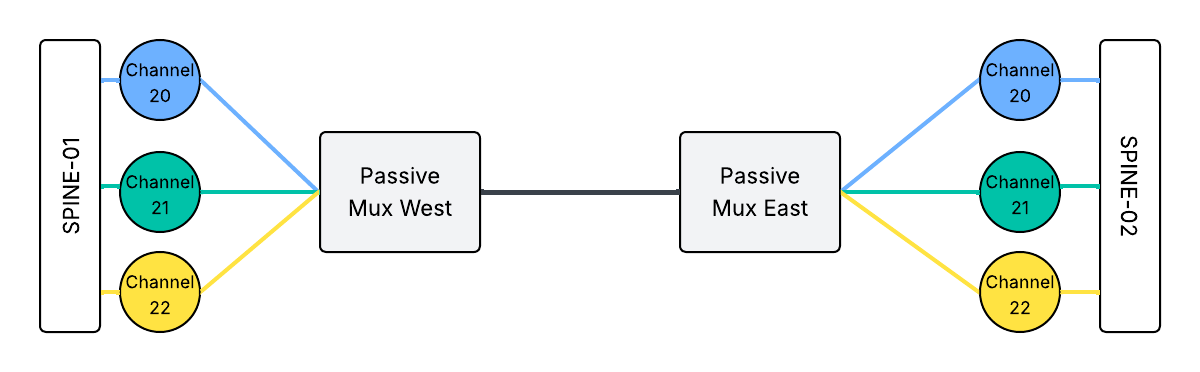
- Along the fiber path, we place OADMs at each network service location. Each OADM "drops" two dedicated channels for that site from the incoming west fiber, while allowing all other channels to pass through untouched. It then "adds" the site's channels back onto the east fiber.
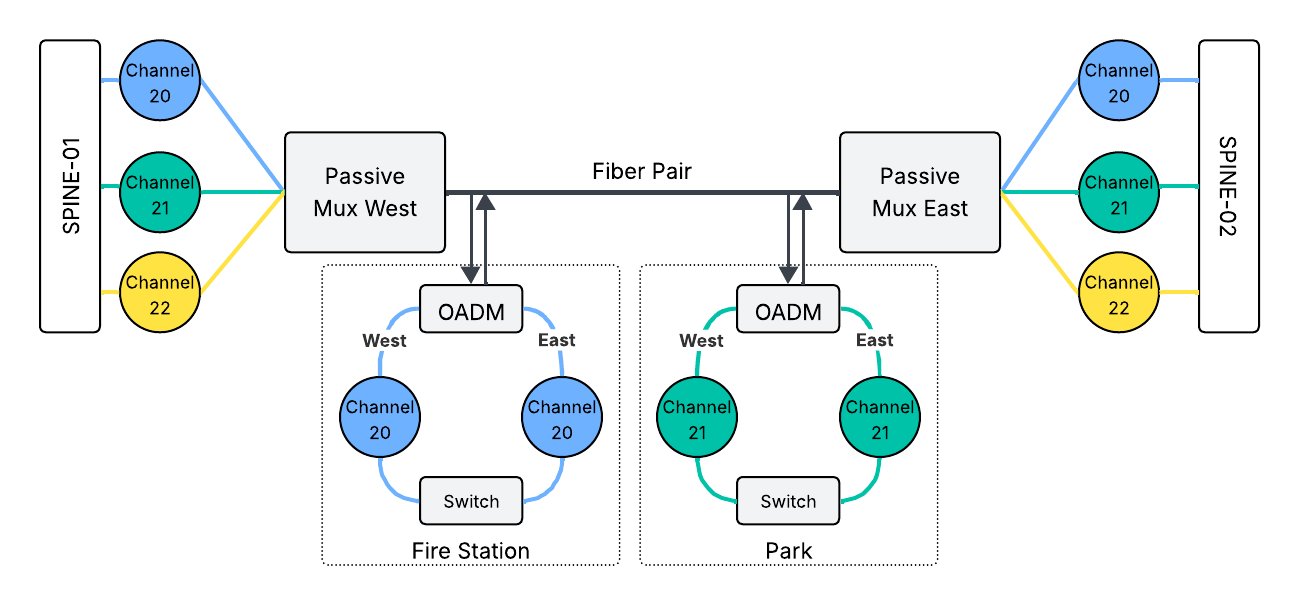
This unique approach gives every site the equivalent of four dedicated fiber strands in each direction—while using just two physical strands total. By chaining multiple OADMs, we efficiently serve numerous locations across the same fiber pair, making the design both cost-effective and highly scalable for future growth.
Today
Celina has transformed into one of the fastest-growing communities in the Dallas-Fort Worth metroplex. Our population has more than doubled to approximately 60,000 residents and is projected to reach an ultimate buildout of 380,000.
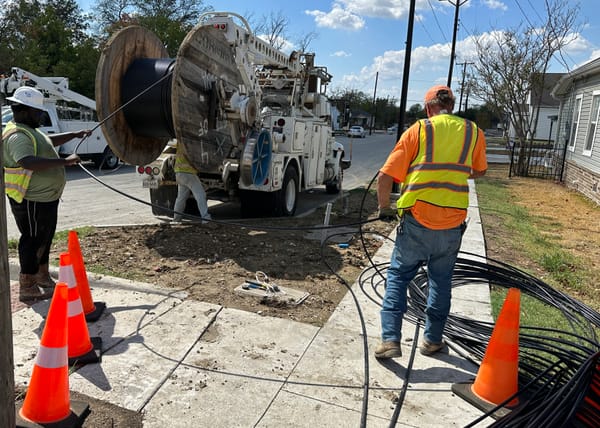
We have completed the install of 30 miles of City-owned fiber, with a master plan targeting a full buildout of 100 miles. We are currently operating 25+ fiber-connected city sites running Arista AVD Layer 3 EVPN/VXLAN, delivering reliable, high-performance connectivity to critical City services.
Our network expansion continues at full speed. Phase 4, currently under construction, will add another 7 miles of fiber creating the second and third physical rings. Phase 5 is already planned to bring an additional 9 miles, further extending our reach and capacity as new facilities come online.
This steady, deliberate investment in fiber infrastructure — paired with our modern Arista-validated leaf-spine architecture — ensures Celina’s network remains agile, resilient, and ready for whatever scale the future demands.
Looking Ahead: Automation for Operational Excellence
With the physical and logical foundation in place, the next frontier is automation. We're leveraging Arista CloudVision Studios to drive full network configuration automation based on our AVD design.
This will deliver:
- Standardized, error-free configurations across the entire network.
- Faster, simpler deployments for new sites.
- Reduced operational overhead and minimized downtime.
- Consistent, reliable experiences for our teams and the citizens we serve.
By combining modern architecture, intelligent fiber optimization, and automation, Celina is building a network that doesn't just meet today's needs—it anticipates tomorrow's opportunities.
We're proud to lead with innovation in municipal infrastructure, ensuring our public services remain resilient, efficient, and ready for whatever growth brings next.
 Arista Networks